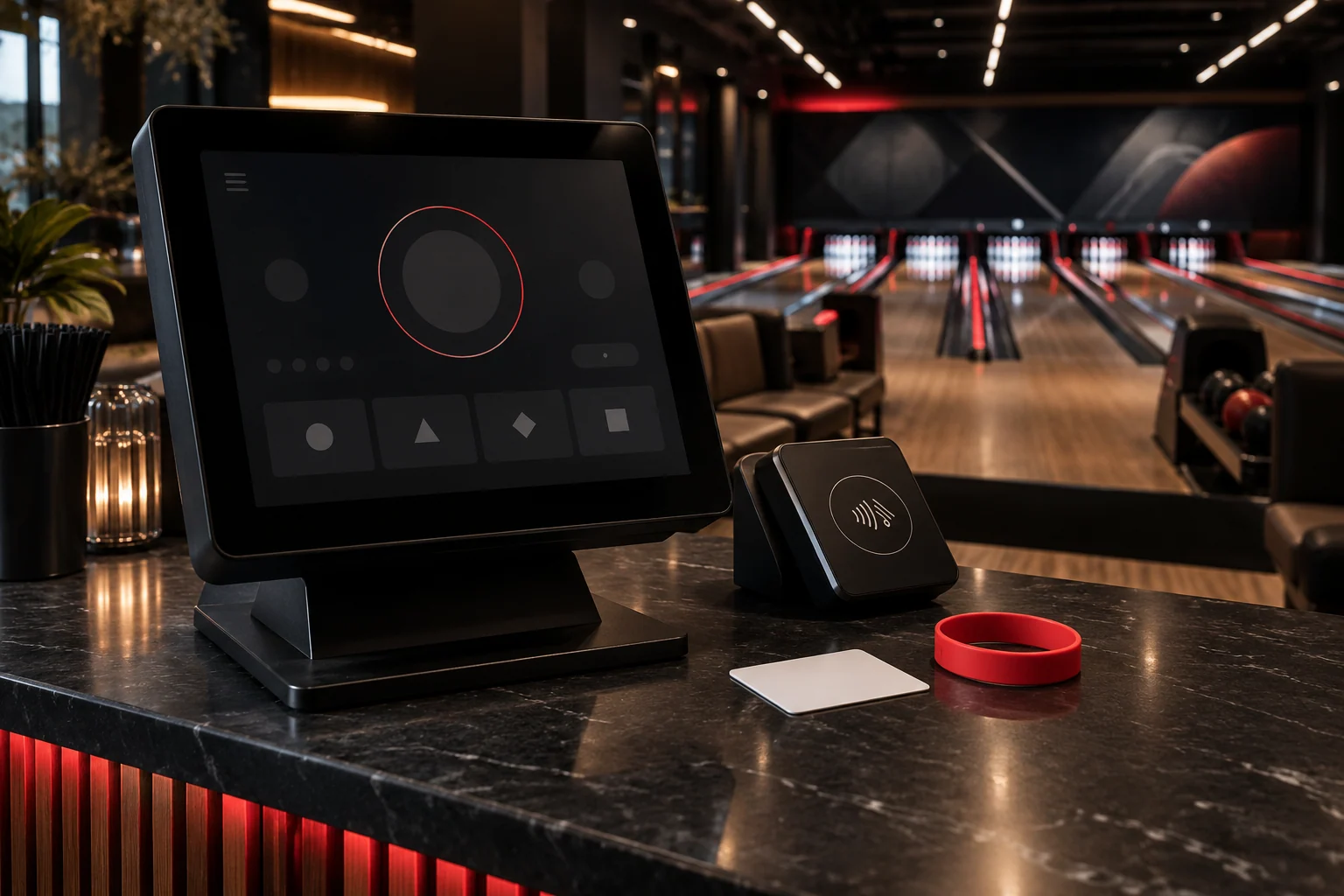
A connected guest journey. Illustrative hardware and interface concept.
Bowling software should help the team run the center and help management understand the business. OBED starts with your processes, then evaluates the software functions and connections required to support them.
01
Manage lanes and reservations together
Define lane management, booking rules, reservations, walk-ins and session timing around real capacity. Make availability and operational responsibilities clear across reception and management.
A useful workflow must distinguish what is booked, what is available and what the team can actually deliver. We consider online reservations and reception changes together, including late arrivals, group changes and session extensions where the selected platform supports them. These scenarios form part of the selection brief.
02
Make groups and events manageable
Structure group bookings, events, birthday parties and packages with consistent rules. Consider lane allocation, participant numbers, deposits or payment stages where supported, and coordination with F&B.
An event has operational details that a simple calendar entry cannot express on its own. The team needs to understand the number of participants, lanes, included items, activity sequence and service requirements. We help structure those requirements so that the offer can be sold and delivered consistently.
Bowling, hospitality and the guest journey. Illustrative venue concept.03
Connect the guest relationship
Guest profiles and loyalty can help create a more consistent return experience. We define what information is necessary, who can access it and how it should connect across the venue.
A returning guest should receive a coherent experience, while the team should only handle the information it needs. We map the role of guest profiles, package history and loyalty alongside access permissions and the chosen account model. Any data migration is scoped separately rather than assumed.
04
Bring F&B and payments into the workflow
We assess POS integration and connections with F&B and cashless systems. Interfaces, data ownership and system responsibilities are verified with the suppliers before an integration is promised.
The systems may remain distinct while exchanging agreed information. For example, a lane booking and an F&B sale can have different owners, rules and records. Cashless venue management should be considered alongside those responsibilities, not treated as a universal replacement for every platform.
05
Turn reporting into operational control
Define the reports management needs: lane utilization, booking patterns, package activity and revenue. The available detail depends on the selected system and the data captured.
A report is useful when it supports a decision. We work backwards from the questions management needs to answer: which sessions fill, where packages create pressure, how sales are distributed and which operational exceptions recur. Definitions and reconciliation matter as much as the appearance of a dashboard.
06
Choose the workflow before the platform
Map current pain points, must-have functions and migration requirements. Then assess demonstrations and supplier documentation against your operation, including staff training and implementation support.
Before rollout, use representative operating scenarios to check the setup. Include a normal booking, a group event, a changed reservation and an end-of-day review. Staff preparation, access rights, fallback procedures and the transition from existing tools should be agreed before switching over.
A practical project outcome
What we can develop with you.
The exact deliverables and level of involvement are agreed for your engagement.
A workflow and functional requirements brief.
A map of existing systems and required connections.
Implementation scenarios, staff preparation and handover requirements.
Before we begin
Practical questions. Clear answers.
Can we keep our existing POS?+
Possibly. We first identify the POS, bowling platform and connection you need. Supplier-supported interfaces, version requirements and implementation responsibilities must be checked before compatibility is confirmed.
Does booking software also control the bowling equipment?+
That depends on the platform and setup. Reservations, lane control, scoring and payment may be handled by different components. We map which system is responsible for each part and how the workflow should connect.
Can birthdays and events be included?+
They form part of the requirements we help define. The chosen setup must support the actual package rules, timing, lane allocation and F&B coordination. We check the required functions with the platform supplier.
Can customer and booking data be migrated?+
Migration depends on the source system, the available export and the receiving platform. We review what data is needed, what can be transferred and how it should be checked. It is scoped separately from a basic software installation.